Key takeaways
- Drops add water. Most dry eye is missing oil.
- Blocked oil glands (MGD) are behind most cases — 86% in one study of 299 patients.
- Watery eyes can still be dry eyes. The tears are there; they just don't stay.
- Untreated, oil glands can shrink and stop working for good. Early care saves glands.
- A real dry eye exam images the glands, so treatment matches the cause.
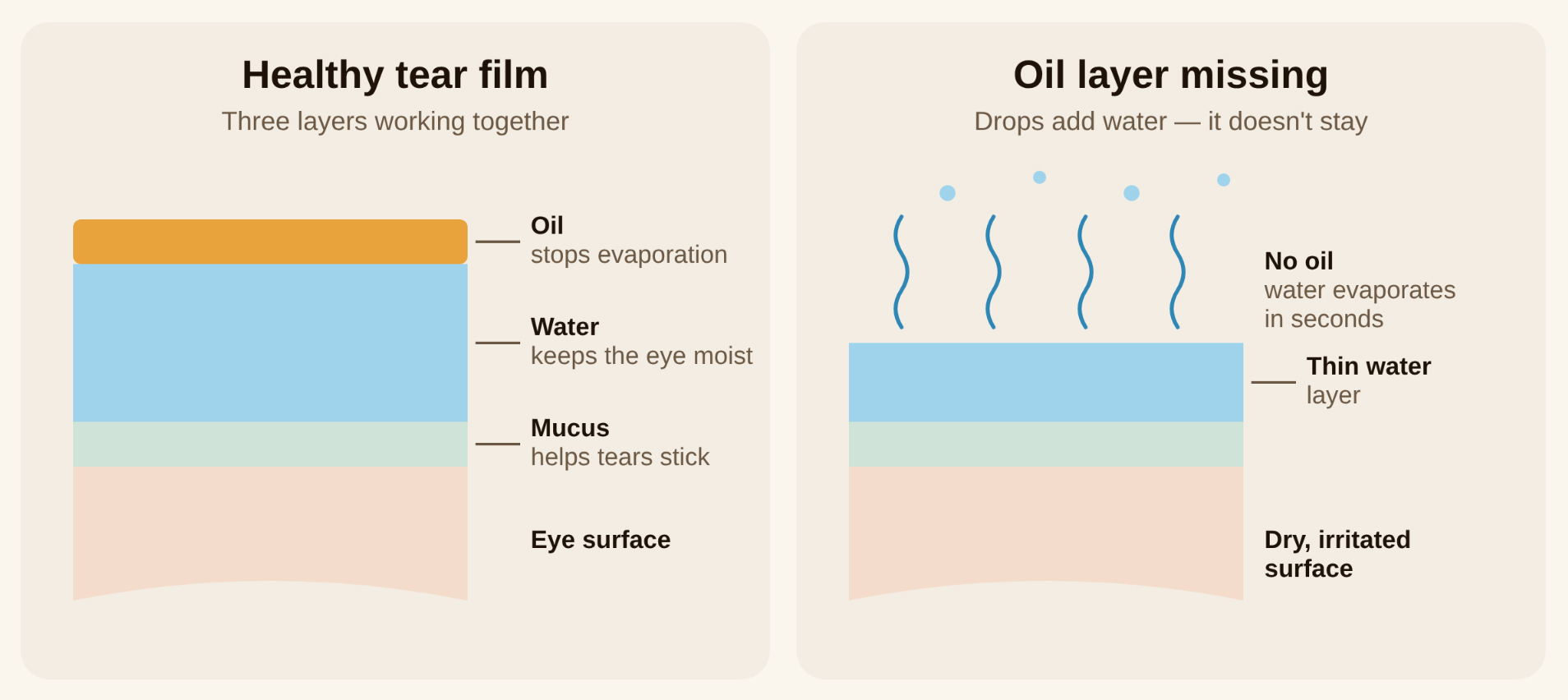
Your tears have three layers. Drops replace one.
Oil
The top coat. Stops evaporation. Made by the meibomian glands in your eyelids.
Water
The middle layer. Keeps the eye moist and washes away debris. This is what drops add.
Mucus
The base. Helps tears spread and stick to the surface of the eye.
If the oil layer is missing, the water is gone in seconds — so you reach for another drop. It’s like refilling a pool that has no cover on a hot day.
Two kinds of dry eye
Not enough tears. Called aqueous-deficient dry eye. The tear glands don’t make enough water. Less common on its own.
Tears evaporate too fast. Called evaporative dry eye, and usually caused by MGD. This is the most common kind.
Many people have some of both. A 2012 study of 299 dry eye patients, published in Cornea, found MGD in 86% of them. That’s why drops alone so often fall short.
Signs it's your glands, not your tears
- Eyes feel worse at the end of the day or after screens
- Watery eyes that still feel dry
- Crusty or red eyelid edges
- Vision blurs, then clears when you blink
- Drops help for 10 minutes, then nothing
- Contact lenses feel scratchy by afternoon
What causes blocked glands?
Age, screens, menopause and hormone changes, rosacea, contact lenses, some medications, and past eye surgery.
Screens are a big one. When we focus on a screen, we blink less often and less completely. Every half-blink is a missed chance to squeeze fresh oil out of the glands.
Left alone, glands can shrink and stop working for good. Lost glands don’t grow back. That’s the strongest reason to treat early.
Not all drops are the same
- Artificial tears add moisture for a short time. Good for mild, occasional dryness.
- Preservative-free tears are gentler if you use drops more than a few times a day.
- “Get the red out” drops shrink blood vessels for a whiter look. Overuse can cause rebound redness.
- Prescription drops target inflammation. They can help, but they don’t clear blocked glands.
Drops vs. treating the cause
| Artificial tears | Prescription drops | In-office gland treatment | |
|---|---|---|---|
| What it targets | Moisture, short-term | Inflammation | Blocked glands + inflammation |
| Relief lasts | Minutes | Weeks to months of daily use | Months between maintenance visits |
| Fixes the oil layer? | No | Partly | Yes |
Still burning after all those drops?
It's probably your oil glands. Book a dry eye exam with Dr. Miglani and see what's really going on.
How do you find out what's wrong?
A real dry eye exam goes beyond “your eyes look a little dry.” Dr. Miglani looks at:
- Your symptoms. When they happen, what makes them worse, what you’ve tried.
- Tear breakup time. How many seconds your tears stay stable after a blink.
- Gland imaging. A picture of the glands inside your eyelids — how many are open, blocked or gone.
- Oil quality. Gentle pressure on the lid shows whether oil flows clear or comes out thick.
Then the plan matches the cause. See in-office IPL and radiofrequency →
What you can do at home
- Use a heated eye mask that holds warmth for several minutes.
- Clean your lid margins daily with a gentle lid cleanser.
- Take screen breaks and blink fully.
- Switch to preservative-free drops if you use them often.
- Run a humidifier in dry, heated rooms in winter.
What about fish oil? A large NIH-funded trial of 535 people, published in the New England Journal of Medicine in 2018, found omega-3 supplements worked no better than placebo for dry eye.
When to see a doctor right away
Dry eye is uncomfortable, not usually urgent. But call an eye doctor promptly if you have real eye pain, sudden vision changes, strong sensitivity to light, or discharge. Those can be signs of something other than dry eye.
Dry eye help in Monroe Township, NJ
Monroe Eye Care, 1600 Perrineville Rd., Suite #55, Monroe Township, NJ. Led by Dr. Shefali Miglani, OD. Patients come from Concordia, Rossmoor, Clearbrook, Greenbriar and across Middlesex County.
Watch: Dr. Shefali explains dry eye
Videos from Dr. Shefali. Find more on her channel.
Dr. Shefali on dry eyeA video from Dr. Shefali MiglaniWatch on YouTube → A quick tip from Dr. ShefaliA short video from Dr. Shefali MiglaniWatch on YouTube →More videos: Monroe Eye Care on YouTube
Frequently asked questions
Are some drops making it worse?
"Get the red out" drops can cause rebound redness. Preservatives can irritate with heavy use.
Why are my eyes watery if they're dry?
When the surface dries out, your eyes flood with reflex tears. Those tears are mostly water with little oil, so they run off or evaporate fast — and the dryness returns.
Can blocked glands come back?
Yes, if not treated. Catching it early saves glands.
Do warm compresses work?
They help mild cases. Most store-bought methods don't get hot enough, long enough.
Is dry eye worse in winter?
Often, yes. Indoor heat and dry outdoor air speed up evaporation. A humidifier and regular screen breaks help.
Can dry eye damage my vision?
Dry eye can blur vision on and off. Severe, untreated cases can harm the eye's surface, so persistent symptoms deserve an exam.
Stop guessing. Get answers.
Book a dry eye exam online. We image your glands and match treatment to the cause.
Go deeper with Dr. Shefali
Dr. Shefali shares short videos and everyday eye-health tips — what really helps dry eye, what doesn't, and simple habits that make a difference. Follow along so you never miss one.
Sources and further reading
More from Dr. Shefali: Videos on YouTube · Tips on Instagram
- MGD in 86% of dry eye patients — on Lemp et al., Cornea, 2012.
- Omega-3 fish oil supplements no better than placebo for dry eye — National Institutes of Health, 2018.
- FDA authorizes IPL device to manage dry eye disease — Ophthalmology Times, 2021.